
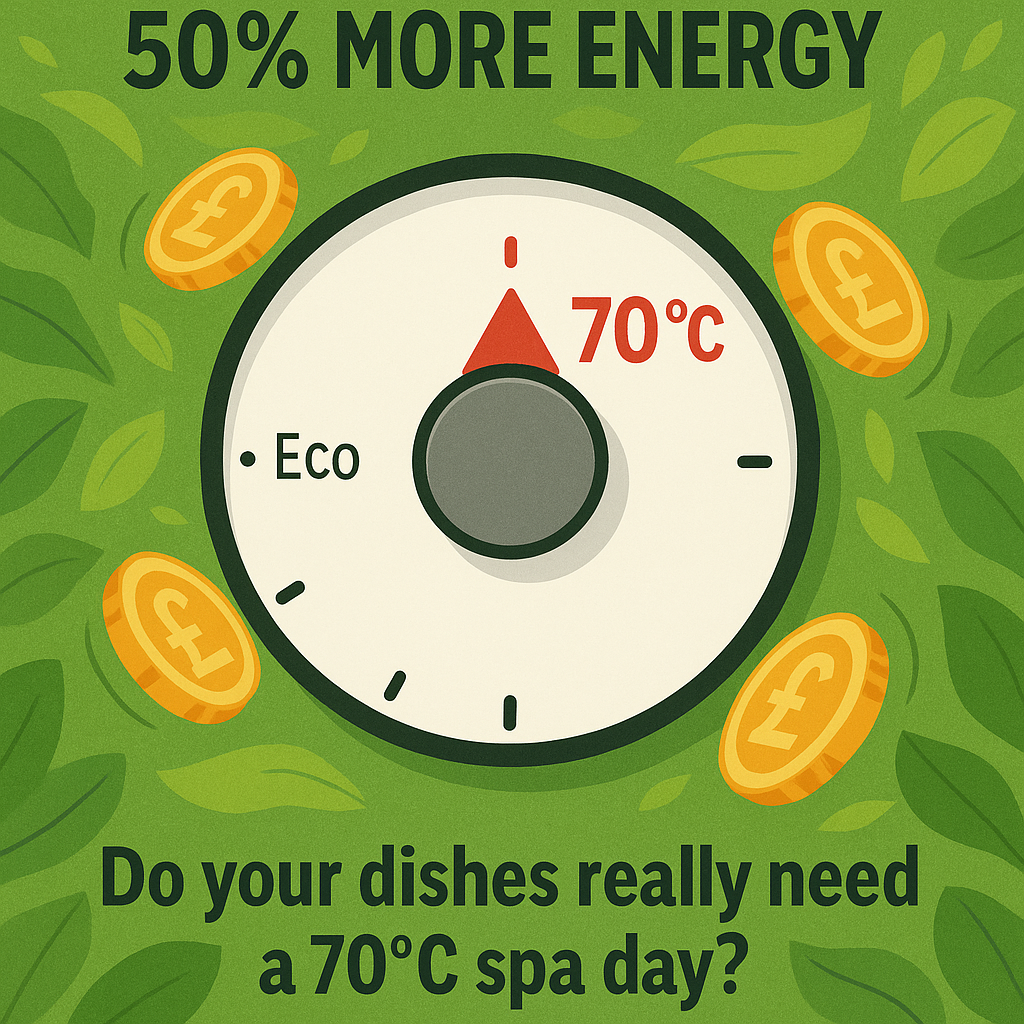
Most of us don’t give much thought to the temperature setting on our dishwasher.
Eco. Normal. Intensive.
We pick the one that sounds right and hit start.
But what if that choice meant a tangible difference in your energy bill, and your carbon footprint?
Let’s break it down.
Heating Water = Energy. The Higher the Temp, the More It Costs
Dishwashers typically heat water from your cold supply, usually around 10°C in the UK.
The most common settings are:
Eco/Normal Wash: ~50°C Intensive Wash: ~70°C
Heating that extra 20°C doesn’t sound like much… until you do the maths.
Quick Calculation: Energy to Heat 10L of Water
Using the formula:
Q = ṁ.Cp.ΔT
Where:
m = 10 kg (10 litres of water) c = 4.18 kJ/kg·K (specific heat of water) ΔT is the temperature rise
50°C Wash (ΔT = 40°C): 10 x 4.18 x 40 = 1,672 = 0.464 kWh
70°C Wash (ΔT = 60°C): 10 x 4.18 x 60 = 2,508 kJ = 0.697 kWh
Difference per cycle: 0.697 – 0.464 = 0.233 kWh extra
Over a Year (1 Wash/Day): 0.233 x 365 = 85.05 kWh/year
At 30p/kWh, that’s circa £25.50/year just for turning up the heat.
The Bigger Picture
If 10 million UK households ran one hotter cycle daily, that’s 85 million kWh/year, enough to power 9,000 homes annually, and that’s just from dishwashers.
But If We’re Going Net Zero, Does Energy Efficiency Still Matter?
There’s a growing debate, “If we decarbonise the grid, why bother with energy savings?”
It’s a fair question, but here’s the reality:
Net zero doesn’t mean infinite clean electricity. Every kilowatt-hour still needs to be generated, stored, and distributed. Grid strain is real. The more we electrify (EVs, heat pumps, etc.), the more demand spikes—especially in winter. Efficiency reduces infrastructure costs. The less we waste, the fewer upgrades we need to cables, substations, and generation.
In Other Words:
Energy efficiency isn’t about guilt or sacrifice.
It’s about designing a smarter system—
one that’s resilient, affordable, and built for the long term.
Because using less still matters. Even when it’s green.
Leave a Reply